Loading...

TL;DR:
- A feature essay blends factual reporting with storytelling to engage readers through vivid description and emotional depth. It relies on strong leads, clear stakes, specific details, quotes, and a narrative arc to reveal the "how" and "why" behind a subject. Studying diverse examples enhances technique and judgment, essential for crafting compelling, human-centered long-form writing.
A feature essay is defined as a narrative-driven piece of writing that blends factual reporting with storytelling to engage readers on a human level. Unlike a standard news article, a feature essay uses vivid description, character, and emotional resonance to explore the "how" and "why" behind a subject. Studying a strong feature essay example is one of the fastest ways to understand what separates forgettable writing from work that genuinely moves people. The best examples reveal structure, voice, and technique all at once. Tools like Grammarly can help you polish prose, but the real education comes from reading and analyzing finished work that already gets it right.
A strong feature essay example teaches you more than any textbook definition can. Feature stories are described as "chocolate news": factually accurate, but genuinely enjoyable to read. That balance is the first thing to look for when you study any feature article sample.
Here are the core components to identify in every example you read:
Pro Tip: When you read a feature essay example, highlight the lead, circle the nut graf, and bracket every quote. This annotation habit reveals the skeleton beneath the prose and makes the structure impossible to miss.
The human interest profile is the most common feature essay type, and it is also the most instructive for beginners. A classic example is a piece about a first-generation college student navigating financial aid, told through a single day in her life. The writer opens with a scene: the student sitting in a financial aid office at 7 a.m., forms spread across her lap. The nut graf arrives in paragraph three, explaining that millions of students face the same bureaucratic maze each year. The rest of the essay alternates between her personal story and national data on college affordability. This structure teaches you how to use one person's experience to illuminate a universal truth.

Investigative narrative features combine the rigor of data journalism with the readability of storytelling. A well-known feature writing example in this category is a long-form piece examining how a single hospital policy affects patient outcomes across an entire city. The writer interviews nurses, administrators, and patients, then weaves their accounts around documented statistics. Effective feature essays shift from "who, what, when, where" toward "how and why" to engage readers emotionally. This type of feature essay example shows you how facts and human stakes reinforce each other rather than compete.
Historical features place a past event in conversation with the present. A strong example is a feature about a neighborhood that was demolished for urban renewal in the 1960s, written from the perspective of a resident who still lives nearby. The writer uses archival photographs, city records, and the resident's memories to reconstruct what was lost. This approach demonstrates how primary sources and personal testimony can coexist in a single narrative. For students writing history-adjacent essays, this feature essay example is a direct model for how to make old events feel urgent and alive.
How-to features are often dismissed as purely functional, but the best examples of feature writing in this category are genuinely literary. Consider a piece about how a small bakery owner learned to make sourdough during a period of personal crisis. The writer structures the essay around the bread-making process itself, using each step as a metaphor for rebuilding. Instructions appear, but they serve the emotional arc rather than interrupt it. This type of feature article sample teaches writers how to embed practical information inside a story without making the piece feel like a manual.
The braided essay is an advanced narrative form that weaves multiple story strands together. Ed Park's Blizzard essay alternates childhood memories with board game descriptions to reflect on memory and identity. Each strand comments on the others without ever directly explaining the connection. This technique creates meaning through juxtaposition rather than argument. For writers who feel constrained by linear structure, this feature essay example opens up a completely different way of organizing ideas. The braided form works especially well for personal essays that resist a single, clean narrative line.
Place-based features use a specific location as the central character. A strong example is a feature about a dying coal town in Appalachia, where the writer spends two weeks embedded in the community. Every scene is rooted in physical detail: the color of the water, the sound of the mine closing, the way the diner empties by 8 p.m. The most effective feature essays engage readers emotionally while remaining factually sturdy, balancing journalistic integrity with storytelling artistry. This example teaches you that a setting described with precision carries as much narrative weight as any character.
First-person feature essays give the writer permission to be present in the story. A compelling example is a piece by a journalist who spent a month living on minimum wage to report on poverty. The writer's own discomfort, miscalculations, and realizations become the story's engine. This format demands honesty and self-awareness. AI tools can assist with research and synthesis but cannot replace the lived experience needed for deep feature writing. Educators emphasize authentic voice as the irreplaceable element. This feature essay example is a reminder that your perspective, when handled with discipline, is a legitimate journalistic tool.
Studying different types of feature essays exposes writers to varied techniques, from profile storytelling to historical reflection to how-to narratives. The table below organizes the seven examples by type, primary technique, and what each one teaches.
| Type | Primary technique | Key lesson for writers |
|---|---|---|
| Human interest profile | Scene-setting and universal stakes | Use one person's story to represent a larger truth |
| Investigative narrative | Data woven into character accounts | Facts and emotion reinforce each other |
| Historical feature | Archival sources plus personal testimony | Make past events feel present and urgent |
| How-to narrative | Practical steps embedded in story arc | Instructions serve the emotional journey |
| Braided essay | Multiple interweaving narrative strands | Meaning emerges from juxtaposition |
| Place-based feature | Physical detail as character | Setting carries as much weight as people |
| First-person narrative | Writer's direct experience as evidence | Authentic voice is a journalistic tool |
Reading examples is only half the work. The other half is active analysis and deliberate practice. Studying different feature essay types exposes writers to varied techniques that cannot be absorbed passively. Here is how to make examples work for you:
Pro Tip: Annotate every feature essay example you read by writing one sentence in the margin for each paragraph: "This paragraph does X." After three or four essays, patterns emerge that you can consciously replicate.
A feature essay succeeds when it commits fully to both the story and the facts, treating neither as secondary to the other.
| Point | Details |
|---|---|
| Lead with a hook | Open with a scene, anecdote, or striking image that makes readers care immediately. |
| Use the nut graf early | Place the story's significance within the first three paragraphs to keep readers invested. |
| Match type to purpose | Choose human interest, historical, braided, or first-person formats based on your subject and goal. |
| Annotate examples actively | Map structure before admiring style to extract techniques you can apply to your own work. |
| Authentic voice is non-negotiable | AI tools support research and drafting, but lived experience and genuine perspective define the best feature writing. |
Most writing instruction focuses on rules. Feature essay examples taught me that rules are just descriptions of what already worked for someone else. The first time I read a braided essay, I spent an hour trying to figure out why it felt so different from everything else I had read. It was not the subject matter. It was the refusal to explain the connections between strands, trusting the reader to feel them instead. That single insight reshaped how I approach structure in every long-form piece I write.
The writers who improve fastest are the ones who read examples with genuine curiosity rather than just looking for permission to do what they already planned to do. A human interest profile from The Atlantic and a how-to narrative from a regional magazine are both teaching you something, even if the lessons are different. The profile shows you how to scale from the personal to the universal. The regional piece shows you how to make practical information feel worth caring about.
The uncomfortable truth about feature writing is that technique is learnable but judgment is not. Judgment, meaning knowing which detail to include, which quote to cut, and when to let a scene breathe, comes from reading hundreds of examples and writing dozens of drafts. No shortcut replaces that accumulation. Start with the examples in this article, annotate them ruthlessly, and then go find ten more on your own.
— Tilen
Learning from examples is the foundation. Putting that knowledge into practice is where most students get stuck.
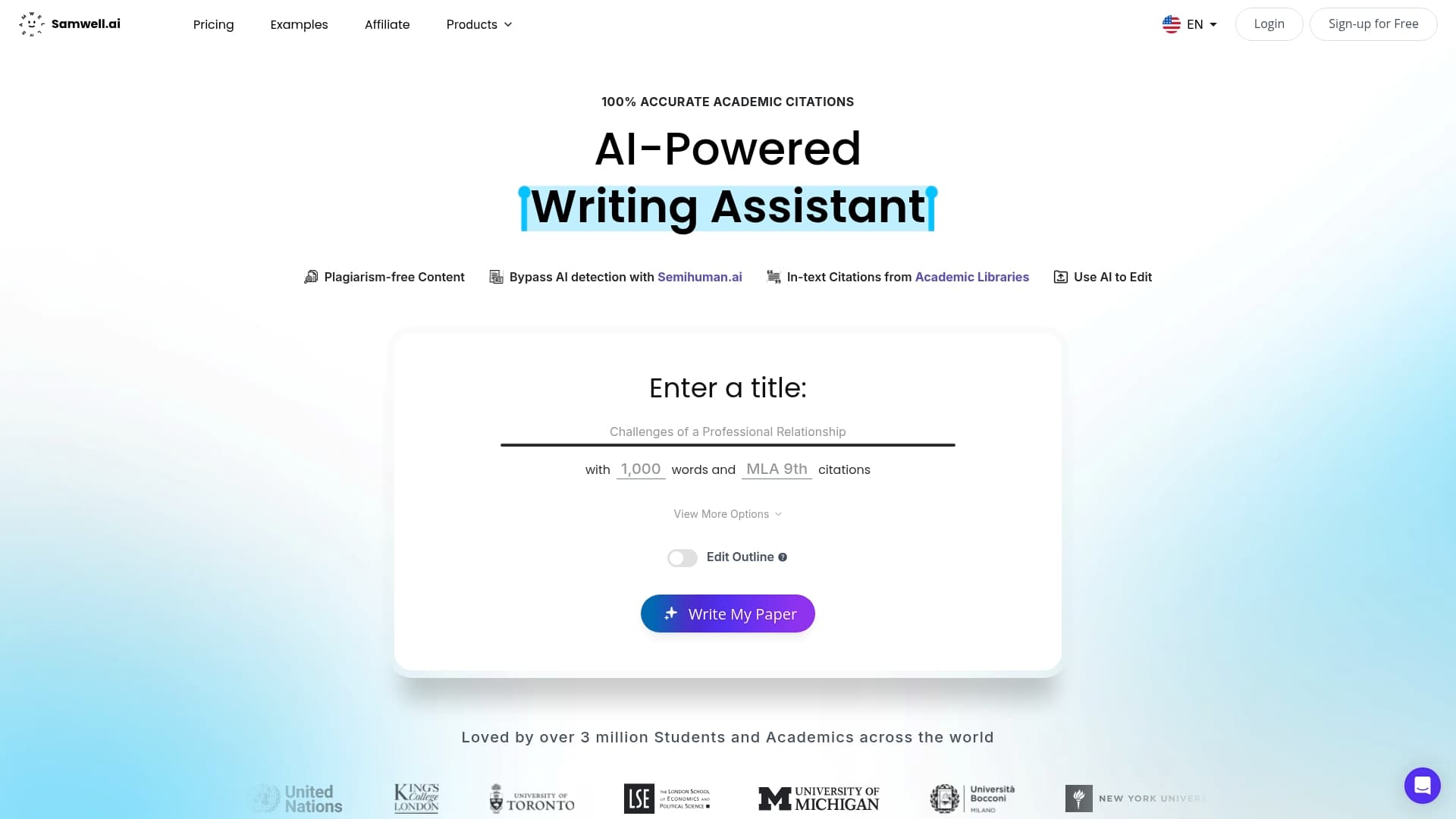
Samwell gives you the tools to move from analysis to execution without losing momentum. The platform's Guided Essays feature helps you build a structured outline before you write a single sentence, so your narrative arc is planned rather than improvised. The Power Editor lets you expand or tighten specific sections based on the techniques you have studied. Samwell also runs real-time AI detection checks, so your work stays original as you draft. Over 1,000,000 students and academics already use Samwell to write research papers with greater efficiency and confidence. If you are ready to apply what you have learned from feature essay examples, Samwell is where that practice becomes publishable work.
A feature essay is a narrative-driven piece that blends factual reporting with storytelling to explore the human dimensions of a subject. Unlike hard news, it uses a story arc with a compelling lead, developed body, and meaningful resolution.
The core components are a hook lead, a nut graf that explains the story's significance, a narrative arc, vivid sensory detail, quotes from real sources, and economical language where every sentence advances the story.
Choose topics where a human story intersects with a larger social, cultural, or historical question. The strongest feature essay topics give you access to real people, concrete scenes, and data that together reveal something readers did not already know.
A feature essay is rooted in factual reporting and journalistic research, while a narrative essay is primarily personal and reflective. Both use storytelling techniques, but a feature essay must be verifiable and typically includes outside sources and quotes.
AI tools can support research, outline building, and drafting, but they cannot supply the lived experience or authentic voice that defines strong feature writing. Use them to organize and refine, then bring your own reporting and perspective to the final piece.